About the author: Nicole Murray is the Founder & CEO of Agape Collective, a Chicago-based marketing, strategy, and community empowerment firm operating at the intersection of arts, culture, and equitable economic development.
This guest blog is part of Elevated Chicago’s ongoing effort to share perspectives from partners advancing equitable transit-oriented development across the region. The views expressed are those of the author(s) and reflect their experiences and expertise. Read more Elevated Chicago guest blogs.
Why Arts & Culture Strategy Matters:
Development shapes how we live, gather, move, and belong. But too often, art and culture are treated as decoration — a mural at the end of construction, a performance at the ribbon cutting. We believe culture is not an accessory to development. It is infrastructure.
Arts and culture strategy matters because artists are visionaries, historians, and truth-tellers. They hold the emotional intelligence of a neighborhood. When we center art & culture in development — particularly in equitable transit-oriented development (ETOD) and community planning — we ensure that growth reflects the identity, memory, and aspirations of the people who live there.
Cultural preservation drives economic vitality and shapes the community as the center of growth. From storefront activation to public art, creative entrepreneurship to cultural programming, artists generate both social capital and financial circulation. When artists are included early and community is built into the process — not as an afterthought — development becomes more sustainable, inclusive, and resonant.
This belief is what led to the creation of the Creatives Table.
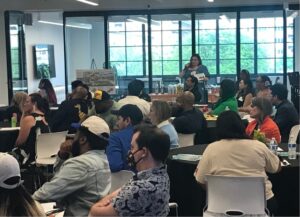
The Creatives Table is more than a meeting. It is a convening space designed to align artists, funders, developers, and civic leaders in shared strategy. It is where ideas become partnerships. Where concerns become solutions. Where creative practitioners gain clarity on funding opportunities, technical assistance, and collaborative pathways.
The Table exists to break silos.
Too often, artists operate separately from institutions. Developers move projects forward without cultural alignment. Funders seek impact without direct connection to community voices. The Creatives Table bridges those gaps — creating space for dialogue, shared language, and coordinated action.
The feedback thus far has been affirming. Artists have shared that they feel seen not just as creatives, but as stakeholders in economic development. Developers have expressed appreciation for structured ways to engage cultural leaders early in project planning. Community partners have highlighted the importance of having a consistent, intentional forum where culture is centered in decision-making.
What we are building is not just programming. It is ecosystem alignment.
When artists and culture-leaders are valued as long-term assets — not temporary activation opportunities — communities thrive. Development becomes more human. Investment becomes more equitable. And culture becomes what it has always been: the foundation.